domingo, 9 de junho de 2013

Female Reproductive System - Hormonal Regulation

Human females follow a cyclical pattern called the menstrual cycle. The menstrual cycle is responsible to release the ovum in the same period as the uterus is most receptive to a fertilized egg.
The menstrual cycle usually takes 28 days to be completely, however it may very from women to women. The cycle is said to begin with menstruation and end with the start if the next menstrual period.
The menstrual cycle is said to be divided in two different, but interconnect, set of events. One takes place in the ovaries and its called the ovarian cycle, while the other takes place in the uterus, and its known as the uterine cycle.

The Ovarian Cycle

Each follicle contains a immature ovum inside. Many follicles degenerate during a girl's life time. In a single ovarian cycle, only on follicle will release a ovum, and then it will turn to a yellowish structure called corpus luteum, which will eventually degenerate. 
The ovarian cycle can be divided into two stages:
  •  Follicular Stage: It all begins with a increase in the level of FSH in the body. This FSH will stimulate the development of one follicle. As the follicle matures, It releases some of the hormone called estrogen and some progesterone. As the level of estrogen increases, the production of FSH decreases and increases the production of GnRH which will stimulate the production of LH. The LH will trigger the release of ovum from the follicle (ovulation). 
  • Luteal Stage: Once the ovum is released, the LH causes the follicle to develop into a corpus luteum. The corpus luteum will secrete some progesterone and estrogen, which will inhibit the production of LH. When the copus luteum degenerates, there is a decrease in the level of estrogen and progesterone. The low levels of these hormones will cause the production of FSH, which will trigger the cycle all over again. 
If the ovum is fertilized and implanted in the endometrium, the level of estrogen and progesterone will remain high in order of the hormone hCG, secreted by the embryo-supporting membrane. Progesterone will maintain the endometrium to support the developing fetus, while estrogen prevents other follicle to mature. 

The Uterine Cycle

If fertilization occurs, it take a few days until the zygote gets to the uterus. Thus, the uterus and endometrium must be prepared. There is a build up of tissues and blood vessels in the endometrium. If fertilization doesn't occur, the endometrium will disintegrates and menstrual cycle will begin all over again.
The uterine cycle start in the same day as the ovarian cycle. As a new follicle starts to be developed and the levels of estrogen and progesterone start to increase, which will cause the endometrium to begin thickening. If the corpus luteum degenerates and fertilization does not occur, the levels of estrogen and progesteron decreases causing the endometrium to break down.

Male Reproductive System - Hormonal Regulation

During a life time, a male individual is able to produce millions of sperm cells. The hormones that triggers this production, are also responsible for the regulation of the male reproductive system.
The release of the hormone GnRH, by the hypothalamus, is able to stimulate the pituitary gland to produce and secrete FSH and LH.
FSH is a hormone that stimulate the testes to produce sperm cells and also to secret the hormone called inhibin, that will act in the negative feedback loop to inhibit the production of FSH. In another hand, LH is not affected by the inhibin. It continuously stimulates the production of testosterone, which will work at the negative feedback loop to inhibit the production of LH. 

Male Reproductive System - Maturation

Puberty is  the period where the reproductive system is fully developed and it is now able to be used. During the period, the boy goes under several physical changes.
Puberty begins when the hypothalamus secretes GnRH. This hormone acts on the anterioor pituitary gland, causing it to release two different sex hormones: FSH and LH. These hormones causes the sperm to testes to produce sperm and testosterone.
Most men experience a condition called andropause, which is the gradual decline of testosterone due age. The symptoms are fatigue, depression, loss of muscle.  

sábado, 8 de junho de 2013

Sexually Transmitted Infection (STI)

HIV/AIDS


AIDS is a disease caused by a group of virus that are called human immunodeficiency virus, or HIV. This virus attacks a particular type of white cell, the helper T cells, which form part of the immune system.  As the level of white cells decrease, the individual becomes more vulnerable to infections that may lead to sickness and death.
HIV is transmitted through sexual contact with a infected individual, shared needles or from mothers that are infect that infect their children during birth or breast-feeding.
There are no cure for HIV. Treatments can alleviate the symptoms of some diseases. The best way to combat HIV is to prevent transmission.

Hepatitis

Hepatitis is actually a group of diseases: hepatitis A, B and C. They are all viral infections. Hepatitis A is acquired by drinking contaminated water. Hepatitis B is spread sexually, or by contact with infected blood. Hepatitis C is transmitted by the contact with infected blood.
The symptoms of Hepatitis B are fever, headache, nausea, loss of appetite, and abdominal pain. If propagated it can cause liver failure, liver cancer, and even death. Some people can recovery completely, however, other becomes asymptomatic, which doesn't show any symptom but still can transmitted the disease.
There are vaccine to prevent Hepatitis.

Genital Herpes

Genital herpes is a very common viral STI. ONE OUT OF THREE SEXUALLY ACTIVE PEOPLE IN CANADA HAS GENITAL HERPES!
Genital herpes is caused by two different viruses: HSV 1, commonly causes infection of the mouth, and HSV 2 that caused genital herpes and is transmitted by genital contact.
The most common symptom is the appearance of blisters in infected areas. It can cause to the individual flu-like symptoms. There is no cure for herpes!

Human Papilloma Virus (HPV)

A group of virus responsible for the genital warts. It is transmitted skin-to-skin contact, which means, condoms cannot prevent this disease. This disease may lead to cancer.

Chlamydia

Chlamydia is a sexual disease caused by a bacterium. It may cause fever and burning pain while urinating. When the woman doesn't treat it, it can be passed to the cervix or the oviduct, which can lead to pelvic inflammatory disease, blocking the oviducts.
Treatments with antibiotics can cure completely Chlamydia.

Gonorrhea
Bacteria that transmits gonorrhea 

It is a bacterial disease.. It causes infections that can lead to painful urination. It can lead to PID and affect the heart and brain. Antibiotic are the cure.

Syphilis

Another bacterial disease. It format rashes in the skin. It can also affect the cardiovascular and nervous system. A infected person can become mentally ill, blind, or acquire heart disease. It can be cured with antibiotics.

Sperm Cell vs Egg Cell


  • Size: The sperms cell are very small compared to the ovum.
  • Energy Reserves: Before ejaculation the sperm is provided with fat, and after ejaculation the sperm use the fructose provide by the fluid secreted by the seminal vesicles, thus, the sperm cell can live for three to five days. In another hand, the egg can only live for one day if not fertilized. If fertilized, it will be implant in the endometrium, which will provide enough energy.
  • numbers produced: Sperm are continuously produced, while eggs are not as much.
  • Motility: The sperm are motile, however the eggs cannot move by themselves.
  • Outer structures: The sperm head has a cap called acrosome, that contains enzymes that will help the sperm to enter the egg. The egg has a outer coating, which in most cases can only be penetrated by the sperm of the same specie. 

Female Reproductive System

The female reproductive system does not mass-produce gonads. The ovaries only produce one egg, or ova.
The ovaries contain the follicles, structures that the ovum develops from. When the ovum is released from the follicle, it is called ovulation.
Structures called fimbriae continually sweep over the ovary and send the ovum to the oviduct, which will direct the ovum to the uterus. The oviduct is the site of fertilization

Male Reproductive System

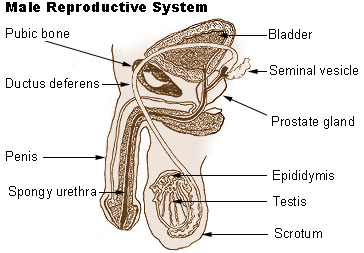
The males reproductive system produce a special type of cell called sperm cell. The sperm cells are produced by the seminiferous tubules inside the testes.
The scrotum is a structure responsible for holding the testes. It regulates the temperature of the gonads, thus, allowing the production of sperm.
Interstitial cells are the cells responsible for the production of the male hormone testosterone. It lies right next to the seminiferous tubules.
The Sertoli cells are a the ones responsible for nourishing and support the developing sperm cells.
The sperm cells are going to develop fully at a structure called the epididymis, from there it goes on the ductus deferens which will take them to the ejaculatory duct and then the penis.

Seminal Fluid

As the sperm cells passes through the ducts deferens, it is mixed with different fluids.
Seminal vesicles produce a fluid that provide sugar (fructose) therefore energy for the sperm cells. The prostate gland and Cowper's gland produce a alkaline fluid that will protect the sperm from the acid in the urethra.